
Guide · Updated September 2026 · 7 min read
Moving to Miami:the neighborhoodscompared.
How Miami’s neighborhoods differ, how people get around, what to know about storms and flood zones, and the paperwork for your first weeks as a Florida resident.
Call or text (305) 407-4323Monday to Friday, 9 AM to 8 PM
In this guide
Before you pack a box.
Miami is many places under one name: separate cities and neighborhoods across Miami-Dade and, to the north, Broward. Some people want a tower with a bay view and a train nearby; others want a big lot on a quiet street. This guide compares the main areas by way of life, then covers the practical side of the move.
At a glance
Two counties, one region.
Miami-Dade County includes the City of Miami, with neighborhoods such as Brickell and Coconut Grove, and separate municipalities such as Coral Gables, South Miami, Pinecrest, Miami Beach and Doral. Fort Lauderdale, to the north, is the seat of Broward County.
Each city can set its own rules on permits and renovations, which matters once you own. The weather sets the calendar, with a wet season and a hurricane season that overlap through the summer and early fall.
Neighborhoods
Miami neighborhoods by way of life.
Start with how you want to spend an ordinary day, then choose the area. Each name links to a local guide, and the neighborhoods page lists them all.
High-rise city living
Brickell is Miami’s financial district along Brickell Avenue, with high-rise condos on Biscayne Bay and Brickell City Centre. Metrorail’s Brickell station and the free Metromover give you options beyond the car.
Historic, leafy streets
Coral Gables, “The City Beautiful,” was planned by George Merrick in the 1920s and is known for Mediterranean Revival architecture, the Biltmore Hotel and Miracle Mile. The city reviews exterior changes closely, so ask early if you plan to renovate.
Coconut Grove, one of Miami’s oldest communities, is known for its tree canopy and bayfront. South Miami, “The City of Pleasant Living,” has tree-lined streets of single-family homes, a downtown on Sunset Drive known as SoMi and its own Metrorail station.
Room to spread out
Pinecrest, along US-1 south of South Miami, is quiet and residential, with large lots (many around an acre), ranch homes and newer estates, and Pinecrest Gardens on the former Parrot Jungle site. It is popular with families.
Life by the ocean
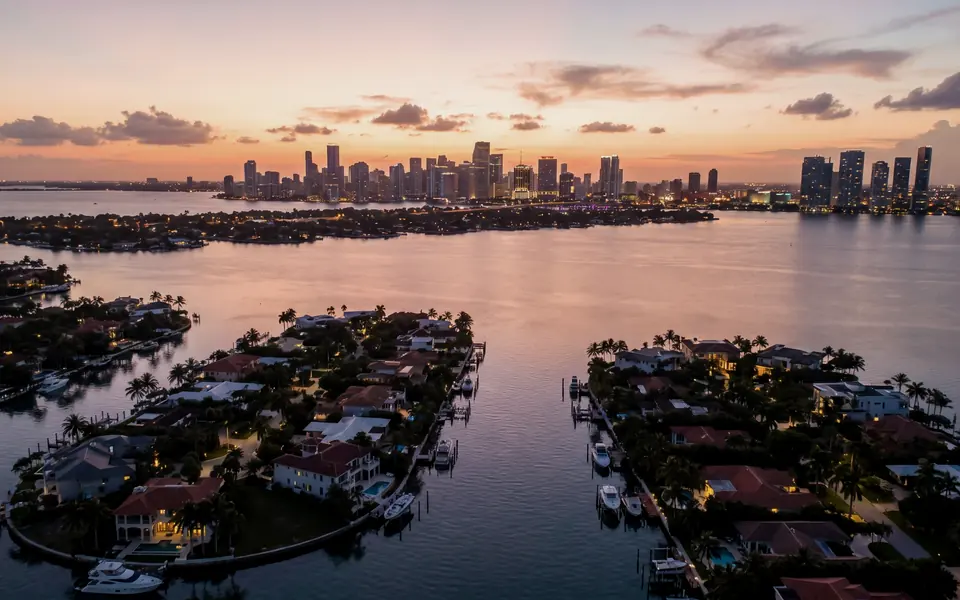
Miami Beach sits on barrier islands between Biscayne Bay and the Atlantic: South Beach with its Art Deco Historic District, Lincoln Road, Mid-Beach and North Beach, and residential islands in the bay such as the Venetian and Sunset islands.
Close to the airport
Doral, just west of Miami International Airport, is a hub for logistics, warehouses and offices, with Carnival Corporation’s headquarters, CityPlace Doral and Downtown Doral. Need space for a business? See commercial real estate.
Canals and boating
Fort Lauderdale, the “Venice of America,” has roughly 165 miles of inland waterways, Las Olas Boulevard, about 7 miles of beaches and Port Everglades, plus its own airport and a Brightline station downtown. Neighborhoods include Las Olas Isles, Victoria Park, Rio Vista, Coral Ridge and Harbor Beach.
Getting around
Roads, rail and your commute.
Test the drive to work at rush hour before you choose an area. The main routes and lines:
- I-95 runs north from Miami to Fort Lauderdale and beyond; US-1 runs south from downtown through Coral Gables and South Miami to Pinecrest.
- Metrorail runs from Kendall through South Miami, Coral Gables and downtown, with a line to Miami International Airport. The free Metromover serves downtown and Brickell.
- Tri-Rail links Miami-Dade, Broward and Palm Beach counties, and Brightline runs intercity trains with stations including Miami, Aventura, Fort Lauderdale, Boca Raton, West Palm Beach and Orlando.
Living near a Metrorail station, as in Brickell or South Miami, can take some of the driving out of your week.
Rent or buy
Rent first, or buy?
If you do not know the city yet, renting for a while lets you live through a summer, test your commute and learn which streets you like before you commit. If you already know where you want to be, buying now means one move instead of two. A middle path: rent while you search, with a plan to buy.
Emmar Realty handles rentals as well as purchases, so you can plan both with one broker. See the relocation service or read the guide to buying a home in Miami.
Storms and insurance
Flood zones and insurance.
Flood zones are drawn on FEMA’s maps and can differ within a single neighborhood, so check each home, not the area. Look it up on FEMA’s Flood Map Service Center. Standard homeowners policies do not cover flood, and lenders require flood insurance for homes in FEMA high-risk flood zones.
Get insurance quotes for a specific home before you commit to it, and ask for its wind mitigation report, which can lower the premium. Know your evacuation zone too: Miami-Dade maps storm surge planning zones A through E that you can look up by address, and Broward publishes its own evacuation map.
New resident
Your first weeks as a Floridian.
A few deadlines start once you become a Florida resident. According to the state’s motor vehicle agency (FLHSMV):
- Driver license: 30 daysGet a Florida driver license within 30 days of establishing residency.
- Car registration: 10 daysRegister an out-of-state car within 10 days of starting a job, enrolling children in public school or establishing residency. You need Florida insurance first.
- Homestead: by March 1If you own your home and live in it as your permanent residence on January 1, apply to the county property appraiser by March 1.
Check the current rules on flhsmv.gov before you go, since requirements can change.
Your visit
A tour built around your trip.
If you are flying in to look, plan the days before you land. Send Bilal your dates to start.
- A call before you travelTell Bilal your dates, budget, workplace and how you want to live. He suggests the areas worth your time.
- Areas first, then homesThe days are planned so you see the neighborhoods first, then homes grouped by area to save driving time.
- One plan after you fly homeAfter the trip, Bilal coordinates the next steps with you, for a rental or a purchase, in English or Spanish.
01Does Florida have a state income tax?
No. Florida has no state personal income tax. Federal income tax still applies, and so do property taxes and sales tax.
02How long do I have to get a Florida driver license after moving?
According to the FLHSMV, new residents must get a Florida driver license within 30 days of establishing residency. An out-of-state car must be registered within 10 days of starting a job, enrolling children in public school or establishing residency.
03When is hurricane season in Miami?
Hurricane season runs from June 1 to November 30. When you choose a home, check its flood zone and its evacuation zone, and get insurance quotes before you commit.
04Is Miami in a flood zone?
Flood zones are not set city by city. FEMA maps them in detail, and they can differ within one neighborhood. Look up any address on FEMA’s Flood Map Service Center and get a flood insurance quote before you commit.
05Should I rent or buy when I move to Miami?
If you are new to the city, renting first lets you test commutes and neighborhoods before you commit. If you know where you want to live, buying saves a second move. Bilal can help with either, and with timing one after the other.
Next steps
Help for your move.
Pick the help you need now.
Relocating to Miami
Help choosing an area, planning your visit and finding a home, in English or Spanish.
See relocation help
Buying a home
From the first tour to the keys, with a broker who knows the areas.
See the buying service
Renting first
Ask Bilal about rentals while you get to know the city.
Ask about rentalsPlanning a move to Miami?
Tell Bilal your dates and what you need. He replies within 24 hours, in English or Spanish.